REVIEW · OAHU
Honolulu Haunts and Hauntings Ghost Tour
Book on Viator →Operated by Honolulu Haunts By Us Ghost Adventures · Bookable on Viator
Honolulu at night comes with a chill. This ghost tour uses real buildings and real dates, then adds ghost lore you’ll want to think about. Guides like Jade and Lon set the tone fast, with a paced stroll that keeps you focused on the sights rather than just jump scares.
I really like the balance here: you get history-first framing at major sites and then the spooky stories tied to them. I also like the format—about an hour, usually with a small group—so you can ask questions and actually hear the guide, not just listen to a lecture from far away.
One thing to consider: the ghost side isn’t equally intense at every stop, and a few stories can feel more rumor-flavored than documented, depending on the guide. If you’re hoping for a hard-historical fact parade only, you may feel the mix is lighter than expected.
In This Review
- Key things you should know before you go
- The route makes the haunting feel real
- Price and what you actually get for $32
- Stop-by-stop: what you’ll see and why it matters
- Iolani Palace grounds: royalty, a coup, and lingering spirits
- Kaua’nona’ula intersection: a name that sounds like a warning
- An old building and the white kimono story
- Supreme Court grounds: orphanage days and banyan-tree echoes
- Old church and cemetery: whispers, smells, and a young boy
- The oldest missionary homes: Protestant beginnings and childhood sounds
- How the guides shape the experience (and why that affects your night)
- The atmosphere: spooky, but not guaranteed to be intense
- Who should book this tour
- Should you book Honolulu Haunts and Hauntings?
- FAQ
- How long is the Honolulu Haunts and Hauntings Ghost Tour?
- How much does the tour cost?
- Where do I meet for the tour?
- Is the tour in English?
- Do I get a mobile ticket?
- How many people are in the group?
- Is food or drink included?
- Is transportation included?
- Is tipping included in the price?
- Is the tour suitable for families or kids?
- What is the cancellation policy if I change my plans?
Key things you should know before you go
- Short and walkable: about 1 hour on foot, with a route that stays fairly easy for most people.
- Small-group energy: the cap is 35, and in practice you may get a very intimate group.
- Major landmarks, not random alleyways: Iolani Palace area, old church grounds, and historic courts.
- Ghost stories with a respectful tone: the tour repeatedly steers you toward treating sacred places carefully.
- English-only, mobile ticket: you’ll get a mobile ticket and confirm in time to plan your evening.
The route makes the haunting feel real
This tour hits that sweet spot between city sightseeing and spooky folklore. Instead of sending you sprinting from one paid “haunted prop” to the next, you walk past places that already carry weight—royal grounds, old courts, cemeteries, and missionary-era buildings. At night, those textures matter: shadows get sharper, street noise fades a bit, and your brain starts doing the rest.
At the start, you’ll meet at 447 S King St and the tour loops back there when you’re done. It’s not a half-day ordeal, so you can pair it with dinner nearby without wrecking your whole schedule.
The big value for me is that you’re paying for a guided story circuit: history gets you oriented, then ghost lore gives you something to picture. It’s the kind of evening activity that fits first-timers who want to understand Honolulu beyond beaches and hotels.
You can also read our reviews of more tours and experiences in Oahu.



Price and what you actually get for $32
It’s $32 per person for about an hour, with all fees and taxes included. You’re also getting professional, courteous guides plus stories described as intensely researched, along with documented accounts of paranormal activity. That matters because ghost tours can range from campfire storytelling to “pay for vibes only.” Here, the selling point is that the guide connects legends to specific sites and events.
What’s not included is also pretty clear: tips, food or drink, and motorized transportation. So think of this as an evening add-on, not a full experience day. If you plan it like that, the price feels fair for the time you spend and the focus of the stops.
Stop-by-stop: what you’ll see and why it matters
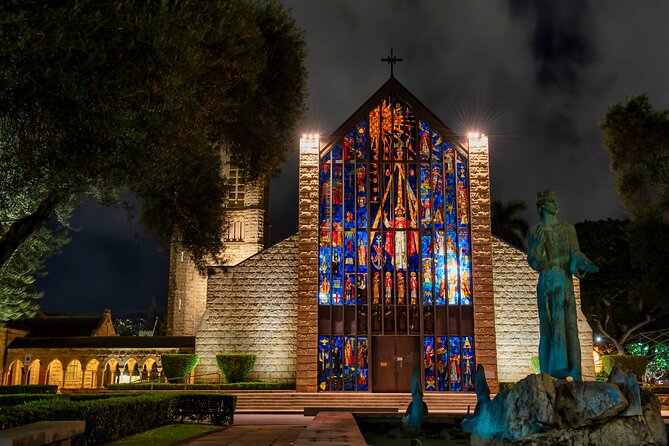
Iolani Palace grounds: royalty, a coup, and lingering spirits
You begin with the Iolani Palace area, built in the late 1800s and described as a sacred place with a powerful past. You’ll hear about royalty and the dramatic event of a coup tied to a sitting monarchy—an episode that sits unusually high in American political history.
Then the story shifts to the human layer. The tour frames the last queen as someone who fought for a free Hawaii until her death, and her spirit is said to still linger, watching over Honolulu.
Why this stop works: it gives you an emotional anchor. Even if you don’t buy the paranormal angle, the setting is unmistakably haunted by the realities of power, colonization, and loss. At night, the mood lands faster because the palace silhouette is already intense.
Possible drawback: if you’re expecting the tour to be nonstop eerie here, you might find the palace segment more reflective than jumpy.
Kaua’nona’ula intersection: a name that sounds like a warning
Next you’re at an intersection called Kaua’nona’ula, meaning rain with the red rainbow. The tour notes there aren’t specific historic events tied to the intersection, which means the draw is mostly the supernatural: creepy stories of unexplained encounters.
This is a useful change of pace. You’re not learning a date-and-document story for this stop—you’re learning the local way of talking about the strange. That’s part of what ghost lore does best: it turns ordinary street corners into places worth remembering.
Practical note: with only one intersection as the “scene,” you’ll get the most from this stop if you pay attention to what your guide is emphasizing, not if you’re scanning your phone for the next photo.






An old building and the white kimono story
Then you move to an older building where stories have piled up over time from workers and customers. The standout rumor is a ghost in a white kimono, so frequently discussed that a news article is said to have followed a tragedy after a host reveals herself to you.
Even when you treat it as folklore, the stop is effective because it makes the ghosts feel tied to real human routines—shops, offices, and daily life. Ghost stories often survive because they’re easy to attach to a place where people already have habits.
Possible drawback: if you’re the type who needs lots of verifiable detail to feel satisfied, you may find this segment more “story-rich” than “document-heavy.” The good news is that the guide’s job here is to connect the rumor to the site, not to prove a supernatural event.
Supreme Court grounds: orphanage days and banyan-tree echoes
You’ll hear about a Supreme Court opened in 1871, a place that became the last resort for cases before serious punishment. The tour also says the grounds once held an orphanage.
From there, the supernatural layer grows more specific. There’s a rumor that if you sit under the banyan trees near the edge of the lot, you can hear the laughter of children playing. People also report encountering lost souls of criminals sentenced to death in the early 1900s.
This stop gives you a strong “mix of spirits” theme—innocence, punishment, and the way environments hold memories. The banyan-tree idea is the kind of image that sticks because it’s visual and almost physical. You can picture yourself under those trees, listening for laughter that may or may not be there.
What to watch for: you’ll likely spend more time thinking than reacting. If you’re chasing goosebumps, this may feel subtle at first—until your imagination starts filling in the gaps.
Old church and cemetery: whispers, smells, and a young boy
The tour then moves to the first Christian church built in Hawaii, which the tour frames as one of the most historic and haunted sites. The cemetery is presented as the state’s oldest, with 296 gravestones, plus a strong claim that many more bodies lie beneath the surface than the markers suggest.
You’ll also hear reports that visitors experience strange smells, quiet whispers, and a ghost of a young boy who wanders the cemetery.
Why this stop is powerful: cemeteries are different. Even if you don’t treat paranormal claims literally, the setting makes the stories feel less like theater and more like a memorial conversation. At night, whispers and sounds become your brain’s “what if” engine.
Practical takeaway: keep your volume low, keep your focus on the guide, and don’t treat it like a photo shoot. If the tour is doing one thing right, it’s pushing respect for sacred ground.
The oldest missionary homes: Protestant beginnings and childhood sounds
Finally, you’ll visit what the tour describes as two of the oldest homes in Hawaii, built by New England missionaries who came to spread Protestant beliefs. This stop centers on reported sightings: ghostly missionary women in long dresses and sounds of children.
You’ll also explore the historic museum aspect, which helps the ghost lore feel connected to actual architecture and early settlement patterns. It’s not only “something spooky happens here.” It’s also “this is what people believed, built, and tried to change.”
Possible drawback: if you’re primarily a hardcore ghost-hunter type, the tour’s tone may feel more cultural than investigative. If you’re open to story and atmosphere, though, this ending lands well.
How the guides shape the experience (and why that affects your night)
Guide style matters more on this tour than you might expect. The guides on record include people like Hope, Jade, Lon, and Terry, and they each bring a different rhythm.
What you should look for, based on the experience you’ll likely get:
- A guide who explains enough history that the ghost stories have context
- A pace that lets you ask questions without feeling rushed
- A tone that treats sacred sites with care
When it’s done right, you’ll walk away with more than scares—you’ll walk away with a better map of Honolulu’s past. One person even highlighted how the pace felt natural rather than rushed, which is exactly what you want when you’re standing in dark outdoor spaces.
One caution: hearing can be an issue. Traffic and street noise are real factors, and one guest noted that a very soft voice can make the tour harder to follow. If you’re sensitive to low audio, pick a spot where you can hear clearly, and don’t be afraid to ask the guide to repeat or slow down.
The atmosphere: spooky, but not guaranteed to be intense
This is not a promise of major goosebumps. The tour seems designed for a mix of chills and cultural context. In practice, the spooky part can range from flickering-light attention to subtle eerie vibes.
That’s not a bad thing. It means you’re not stuck in a hyperactive scare program. You’re seeing the city at night with a guide who turns the details into story.
Also, at least one review indicates the tour is safe for children, which suggests the overall pacing stays family-appropriate. So if you’re bringing teens who like creepy stories but you don’t want a horror-movie format, this could work.
Who should book this tour
Book it if you:
- Want a short nighttime walk that adds meaning to well-known Honolulu landmarks
- Like ghost lore that’s tied to history and place names
- Prefer small-group attention where you can ask questions
- Enjoy a respectful, story-driven atmosphere over loud theatrics
Skip it (or adjust expectations) if you:
- Want strictly verifiable history with minimal folklore
- Are hoping for nonstop paranormal activity or dramatic “proof”
- Get easily frustrated when a story feels rumor-adjacent rather than sourced
Should you book Honolulu Haunts and Hauntings?
If you’re visiting Honolulu and you want one evening activity that makes the city feel older, weirder, and more human, I think this tour is a good call. The price is reasonable for an hour, and the route hits serious landmarks: Iolani Palace grounds, historic court sites, old church and cemetery ground, and missionary-era homes.
My main advice: go in for the blend. Treat the haunting parts like folklore threaded through real places. If you do that, you’ll likely enjoy the walk, the local stories, and the way the night changes how you see Honolulu’s architecture.
FAQ
How long is the Honolulu Haunts and Hauntings Ghost Tour?
It runs about 1 hour.
How much does the tour cost?
The price is $32.00 per person.
Where do I meet for the tour?
The meeting point is 447 S King St, Honolulu, HI 96813. The tour ends back at the meeting point.
Is the tour in English?
Yes, it’s offered in English.
Do I get a mobile ticket?
Yes, mobile tickets are included.
How many people are in the group?
The tour has a maximum of 35 travelers.
Is food or drink included?
No. Food and drink are not included.
Is transportation included?
No motorized transportation is included, so you’ll be walking the stops.
Is tipping included in the price?
Tips and gratuities are not included.
Is the tour suitable for families or kids?
One provided review notes it is safe for children.
What is the cancellation policy if I change my plans?
You can cancel up to 24 hours in advance for a full refund. Less than 24 hours before the start time is not refundable.