REVIEW · FOOD
Hawaii Off The Beaten Path Food Tour
Book on Viator →Operated by Hawaii Free Tours · Bookable on Viator
Chinatown has a smell you won’t forget. This small-group Oahu food walking tour strings together history and flavors from an active Japanese Shinto mission to Honolulu’s Chinatown markets, with you sampling your way through Japanese, Filipino, Chinese, Vietnamese, and Hawaiian-influenced bites.
I love how substantial the food is for the price—this isn’t a toothpick parade. The stops build from manapua and Filipino sweets into big-hitter seafood like Ama ebi/boton shrimp, chutoro-style tuna, and multiple kinds of poke, plus roast meats and a green pandan cake.
One thing to consider: you’ll stand for much of the tour, and a few tastings may be eaten while standing. If you’re the type who needs lots of seated time, plan around that.
In This Review
- Key things I think you’ll care about
- Why this Oahu food tour is worth your morning
- Price and value: what $150 buys you here
- Getting there: Waikiki pickup, meeting point, and timing
- The route: from Izumo Taishakyo to Chinatown markets
- Stop 1: Izumo Taishakyo Mission of Hawaii
- Stop 2: Downtown Honolulu manapua
- Stop 3: Chinatown turon (banana lumpia)
- Stop 4: Chinatown chicken adobo
- Stop 5: Downtown Kauai wild caught deep-water prawns (Ama ebi / boton shrimp)
- Stop 6: Fresh local fruits (seasonal)
- Stop 7: Oahu Fish Market + Japanese-style seafood tastings
- Chinatown tastings: roast meats, pandan cake, and poke
- Stop 8: Chinatown roast meats
- Stop 9: Vietnamese pandan cake
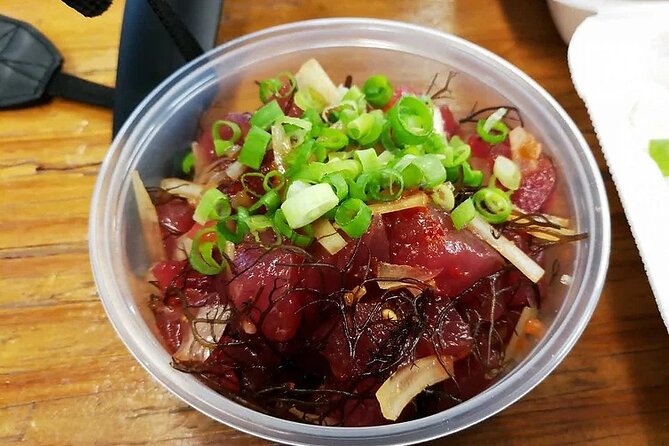
- Stop 10: Hawaiian-style poke (seasoned ahi limu poke)
- What the menu teaches you about Hawaii’s food history
- Standing, eating pace, and how to not feel miserable
- Who this tour fits best (and who should skip)
- Should you book it?
- FAQ
- What time does the tour start?
- How long is the Hawaii Off The Beaten Path Food Tour?
- Is hotel pickup included?
- What if I’m staying outside Waikiki or Honolulu?
- What’s included in the food?
- Are drinks included?
- Do I need to speak a specific language?
- Will I be sitting during the tour?
- Is the tour suitable for people with food allergies?
- What happens if weather is bad?
Key things I think you’ll care about
- Small-group pacing: max 16 (and it’s designed to feel intimate), so you can actually hear your guide.
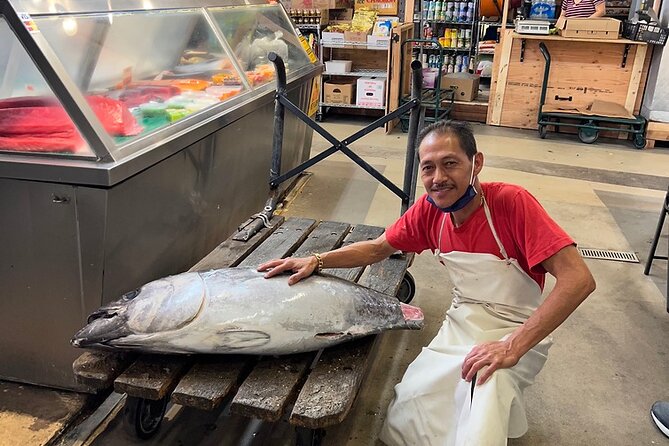
- Real market access: you’re not just peeking at storefronts—you’re walking through active food spaces.
- Seafood focus: deep-water prawns, fish-market tastings, sashimi-style tuna belly, and cooked octopus show up in the plan.
- Seasonal fruit tastings: you’ll sample exotic locally grown fruits depending on what looks best.
- Guides with personality: Victor and TJ are named in many standout accounts for explaining food and culture with energy.
Why this Oahu food tour is worth your morning
Oahu can feel like a choose-your-own-adventure for eating. You’ll find plenty of great restaurants, but it’s easy to get stuck circling the same “safe” places near Waikiki. This tour gives you a shortcut: you get walked through neighborhoods where different Asian and Polynesian food traditions meet, and you eat your way through those overlaps.
What makes it fun is the rhythm. The day doesn’t start with a big fancy sit-down. It starts with you learning the mood of the area—temple, stream-side streets, then into downtown and Chinatown. That flow matters because you’re tasting the island’s food story in the order you’re seeing it.
Also, the tour leans into variety. You’re not choosing between pizza and sushi for three hours—you’re going to see how Filipino manapua sits next to Chinese roast meats, how Vietnamese sweets appear after market seafood, and how Hawaiian poke anchors the end. If you like connecting the dots between cultures, this is a very practical way to do it.
You can also read our reviews of more food & drink experiences in Oahu


Price and value: what $150 buys you here
At $150 for about 3 hours, this tour is priced like a serious food experience, not a budget snack crawl. Here’s why it still tends to feel fair:
- Private hotel pickup/drop-off is included for Waikiki/Honolulu areas. That removes one of the biggest friction points for eating-focused tours.
- Drinks are included: local juice options like lilikoi (passion fruit), lychee, guava, or pineapple, plus bottled water.
- You’re not paying for “one dish.” The plan includes a long list of tastings—manapua, chicken adobo, turon/banana lumpia, local fruits, deep-water prawns, sashimi-style tuna belly, two kinds of poke, Japanese octopus, roast duck, roast pork belly, char siu-style pork belly, Vietnamese pandan cake, and more.
On top of that, many experiences emphasize that you leave very full, with extras you can take home. Even if you’re not trying to pack a picnic, that “leftovers are real” factor is part of the value.
If your goal is to taste widely without spending the rest of the day figuring out where to go, this price makes sense.
Getting there: Waikiki pickup, meeting point, and timing
The tour starts at 9:30 am and ends back around the same meeting spot: 201 N Kukui St, Honolulu, HI 96817.
Pickup is offered only within the Honolulu and Waikiki areas. If you’re staying farther out—Kailua/Kaneohe—or on the west side like Aulani, Ko Olina, or the Four Seasons—you’ll likely need to meet at the first stop instead of being picked up.
You’ll be texted the day before with pickup details and a 15-minute pickup window. In practice, that means you’ll want to be ready right at the start of that window. Don’t plan your morning tightly around it—build in a small buffer.
The route: from Izumo Taishakyo to Chinatown markets
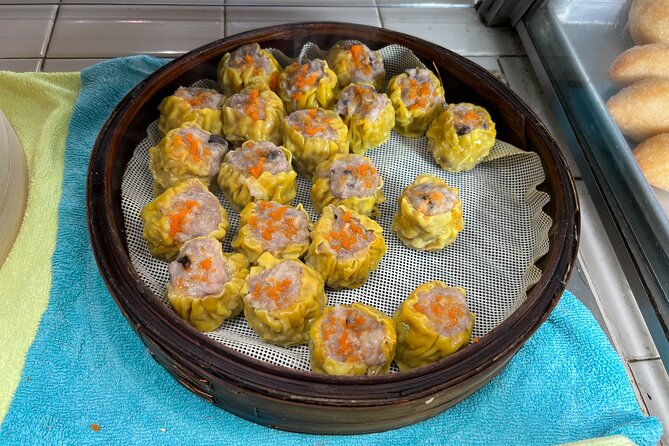
This tour has a neat “story arc.” It moves from a living temple scene to downtown and then into Chinatown’s food world, where the bulk of tastings happen.
Stop 1: Izumo Taishakyo Mission of Hawaii
You’ll spend about 15 minutes at a 125-year-old active Japanese Shinto temple next to the Nuuanu stream. It’s a quick start, but it sets tone. This isn’t just about eating right away—you’re getting context for the Japanese influence you’ll keep seeing later in the food lineup.
Practical note: it’s a short stop, so treat it like orientation. Look around, get your bearings, and keep water handy for the walk ahead.
You can also read our reviews of more tours and experiences in Oahu

Stop 2: Downtown Honolulu manapua
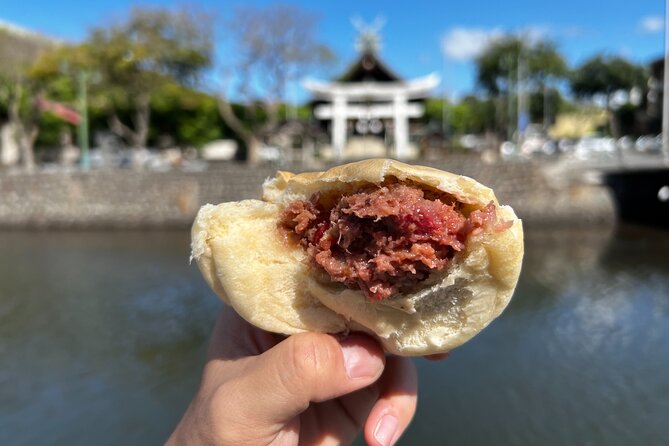
Next you’ll head into local bakery territory for Local Manapua—sweet bread buns with savory meat fillings. This is the kind of food Hawaii does well: it’s comfort food, portable, and perfect for warming up your appetite without heavy spice.
Stop 3: Chinatown turon (banana lumpia)
You’ll try Turon (banana lumpia): Filipino fried banana dessert. Expect warm, crispy, and sweet, which helps your taste buds reset before the next savory stop.
Stop 4: Chinatown chicken adobo
Then comes Chicken Adobo, a Filipino dish marinated and simmered until rich and glossy. This is one of those plates that tastes like it took time—even when it’s served as a tasting.
If you’re the kind of eater who wants flavor that actually sticks with you, adobo is a great anchor mid-tour.
Stop 5: Downtown Kauai wild caught deep-water prawns (Ama ebi / boton shrimp)
This is your seafood break: Ama ebi / Boton shrimp, described as wild caught deep-water prawns. You’ll have about 15 minutes at this stop.
When seafood shows up early, it’s a good sign the tour isn’t just “dessert and snacks.” It also helps you pace your hunger so you’re not completely overloaded when you reach the heavier meat and fish items later.
Stop 6: Fresh local fruits (seasonal)
You’ll move to local exotic fruits. The exact fruits depend on seasons and what looks best that day, but the tastings are meant to be a highlight.
Many favorite moments here are about trying fruits people don’t see back home. One review specifically calls out durian as a standout fruit tasting, so if you’re curious about strong flavors, this stop is where that curiosity gets rewarded.
Stop 7: Oahu Fish Market + Japanese-style seafood tastings
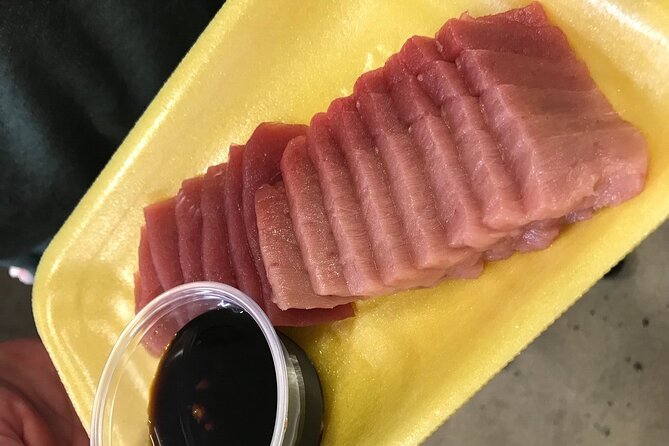
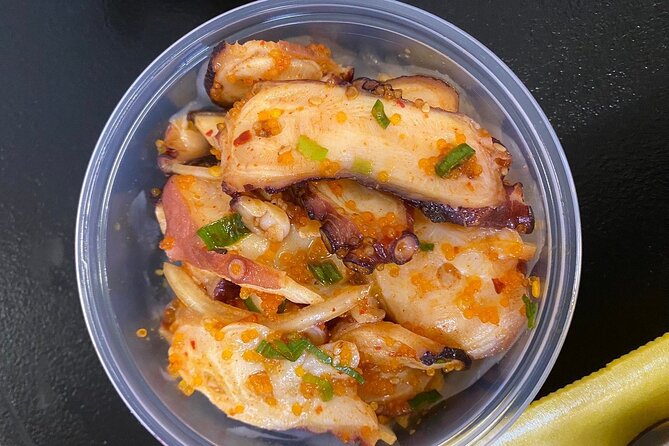
This is one of the biggest “wow” sections. You’ll go to a seafood market for fresh Japanese-style selections, with tastings that depend on availability.
The plan includes:
- Chutoro sashimi: raw sliced tuna belly style
- Tako poke: cooked Japanese tako/ madako in a Korean spicy sauce with flying fish eggs
(And your itinerary also notes “Japanese style seafood” depending on what’s available.)
Timing is about 20 minutes at this stop.
If you’re cautious about raw fish, don’t assume you’ll hate it. The tour specifically frames the tuna belly as fresh, and the overall variety (cooked octopus poke, plus the poke made at the end) gives you options so you’re not forced into a single texture.
Chinatown tastings: roast meats, pandan cake, and poke
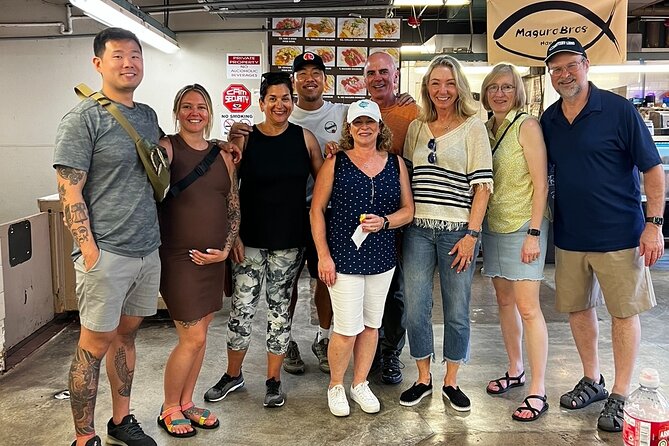
After the fish market, the tour keeps stacking up big flavors. This is where you’ll want to pace yourself and be ready for salty, savory, and rich bites.
Stop 8: Chinatown roast meats
You’ll try Roast Meats—either duck and/or roast pork depending on availability. This kind of stop is gold on an itinerary like this because roast meats teach you a lot about Chinese char siu-style flavor profiles.
Stop 9: Vietnamese pandan cake
Then comes Vietnamese Pandan Cake (about 15 minutes). Pandan flavor reads as tropical and fragrant, and it’s a good shift after heavy meats. It also gives you a dessert that doesn’t just taste like generic cake.
Stop 10: Hawaiian-style poke (seasoned ahi limu poke)
To close, you’ll get Hawaiian Style Poke—raw fish cubed and seasoned locally. No extra introduction needed for poke lovers, and for first-timers, it’s a familiar gateway into Hawaiian flavors.
This ending matters. By the time you reach the final stop, you’ve already sampled:
- Filipino comfort food (manapua, adobo, turon)
- Chinese roast richness (duck/pork/char siu style)
- Vietnamese sweet and fragrant dessert (pandan cake)
- Japanese-style seafood and sashimi concepts
So poke at the end feels like the home base.
What the menu teaches you about Hawaii’s food history
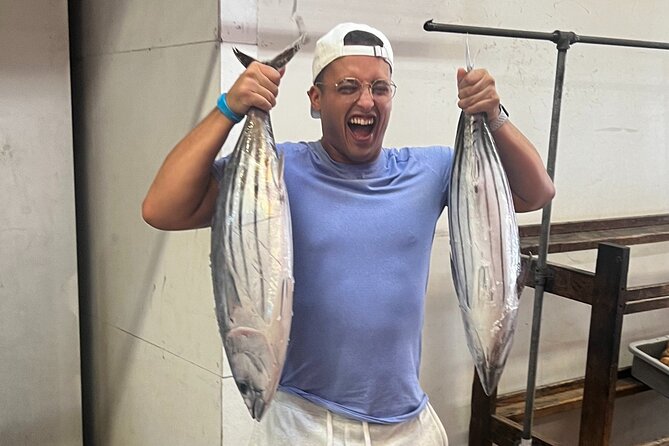
This tour’s best trick isn’t just that it offers tasty bites. It shows you how Hawaii became a crossroads.
You start with a Japanese Shinto mission, then you move into a Chinatown food world shaped by multiple Asian communities. Along the way, the menu quietly maps out cultural movement: Filipino fried sweets and adobo-like braises, Vietnamese pandan desserts, Chinese roast meat traditions, and Japanese seafood styles.
And then Hawaii’s own signature—poke—lands at the end. That structure helps you understand why local food tastes the way it does. It’s not random. It’s layered.
The other teaching moment is pacing. Several stops are short—often 15 minutes—so you taste, walk, and learn in quick turns. That keeps the tour lively and makes it easier to handle big flavor intensity.
Standing, eating pace, and how to not feel miserable
This is a food tour. Your main job is to show up ready.
The tour notes that seating is arranged whenever possible, but you should anticipate standing for most of the tour, and some tastings may be eaten while standing. Several accounts also emphasize that the walking is manageable with an even pavement route.
My practical advice:
- Eat lightly before you go. The menu is long and includes multiple protein-heavy items.
- Sip your included drink when you need it, not only at the end. Local juices help reset your palate between seafood and meats.
- If you don’t eat much raw fish, you can still enjoy the tour—but go in knowing you’ll see both raw fish items and cooked seafood items in the lineup.
Also, bring a good attitude about variety. This tour is built on “try it and see.” The guides are there to help you decide what you like and how to talk about it.
Who this tour fits best (and who should skip)
This is best for:
- First-time Oahu visitors who want a fast education in local food beyond Waikiki
- Food-curious travelers who like seeing multiple cuisines in one morning
- People who enjoy seafood and poke, including those who like tasting different styles of the same ingredient (tuna belly style, spicy tuna poke, Hawaiian-style poke)
- Groups who want a lively tour led by local guides like Victor and TJ, praised for explaining food and culture clearly
You might want to choose differently if:
- You need lots of seated time (the plan leans toward standing)
- You have serious food allergies and haven’t confirmed ingredient safety in advance—this tour specifically asks that serious allergies be contacted before booking
- You’re traveling with strict dietary requirements not covered by the tour’s stated options (the details list classic items, not alternatives)
Should you book it?
If you want a morning on Oahu that feels like local life in action—markets, fruit stands, roast meat counters, and fish freshness—and you’re willing to walk and stand, I think you should book this Hawaii Off The Beaten Path Food Tour. The value is strongest when you count the included pickup, drinks, and the long tasting list that ends with poke.
Skip it only if you strongly dislike standing or you know you won’t eat much of what’s listed. Otherwise, this is one of the easiest ways to leave Honolulu with both fuller tummies and a better food map of the island.
FAQ
What time does the tour start?
The tour starts at 9:30 am.
How long is the Hawaii Off The Beaten Path Food Tour?
It runs for about 3 hours (approx.).
Is hotel pickup included?
Yes, private transportation with hotel pickup and drop-off is included for hotels in the Honolulu/Waikiki area.
What if I’m staying outside Waikiki or Honolulu?
Pickup is only within the Honolulu and Waikiki areas. If you’re staying on the east side (Kailua/Kaneohe) or west side (like Aulani, Ko Olina, or the Four Seasons), you may need to meet at the first stop instead.
What’s included in the food?
The included tastings cover manapua, chicken adobo, turon/banana lumpia, tropical fruit tastings, deep-water prawns, chutoro sashimi, tako poke, Japanese octopus, roast meats (duck and/or pork), Vietnamese pandan cake, and Hawaiian-style poke, plus a sweet honey BBQ pork belly and char siu-style pork belly listed in the sample menu.
Are drinks included?
Yes. The tour includes drinks such as local juice options (lilikoi, lychee, guava, pineapple) or bottled water.
Do I need to speak a specific language?
The tour is offered in English.
Will I be sitting during the tour?
You should anticipate standing for most of the tour, though seating is arranged whenever possible.
Is the tour suitable for people with food allergies?
If you have serious food allergies, contact the operator before booking, since the tour includes multiple dishes.
What happens if weather is bad?
This experience requires good weather. If it’s canceled due to poor weather, you’ll be offered a different date or a full refund.