REVIEW · AUDIO TOURS
Honolulu Historic District a Smartphone Audio Walking Tour
Book on Viator →Operated by Tripvia Tours · Bookable on Viator
Audio history turns downtown Honolulu into a story map. I like the mobile audio format because it keeps the pace yours, and the live GPS map helps you stay oriented without stopping every few minutes. The big plus: you can hear voiced stories at each stop while standing right where the landmarks live. One drawback to plan for: it’s an outdoor walk, so you won’t be able to count on entering ticketed attractions just because an audio stop mentions a site.
This is a straightforward way to get background you’d miss if you just wandered. The route starts at Aliʻiolani Hale and loops through many of the city’s most recognizable civic and cultural buildings, with frequent little “wait, what is that?” moments from the audio. And since it’s private for your group, it works well if you want quiet time to listen without sharing with strangers.
If you’re going during hot hours, I’d go earlier. One short review note I really agree with: the walk can run longer than you think, so morning can make the whole experience feel easier.
In This Review
- Key Points Before You Go
- How the Smartphone Audio Walk Actually Works in Downtown Honolulu
- Price and Timing: $10.99 for 1–2 Hours of Landmark Storytelling
- Stop 1: Aliʻiolani Hale and the Start of the House of Heavenly Kings
- Stop 2: King Kalākaua’s 1879 Building Moment
- King Kamehameha I Statue: Folklore You Can Actually Picture
- Kanaina Building and Victorian Architecture in Hawaii
- Patsy’s Statue, 1879 Reading Rooms, and Keeping Sailors Out of Mischief
- King Lunalilo’s Burial Choice and the City Hall Date Puzzle
- The Weird Sculpture, the Frank F. Fasi Building, and Police Department Notes
- Bell of Nagasaki to the Queen’s Conference Center and Hawaii State Capitol
- From a 1842 Clipper Captain Manor to a Hawaii Art Museum
- Churches, Queen Emma Square, and Names That Shift Over Time
- Pedestrian Mall, Hawaii Theatre Center, and Kumu Kahua Theatre Stories
- What You’ll Probably Love, Based on What Actually Gets Praised
- Should You Book This Honolulu Historic District Audio Tour?
- FAQ
- How long is the Honolulu Historic District smartphone audio walking tour?
- What language is the tour offered in?
- Do I need an internet connection during the tour?
- Does the tour include headphones?
- Are attraction tickets included?
- Do I need a smartphone or tablet?
- Where do I start the tour?
- Is the tour guided by a person?
- Is this tour private?
- What’s the cancellation window?
Key Points Before You Go

- Offline-friendly setup: download on Wi‑Fi first, then the tour can run without using data while you walk.
- GPS route tracking: a live map shows your route and where you are.
- Skip without guilt: if a stop isn’t grabbing you, you can move on and finish at your own rhythm.
- Earbuds help: audio can be quiet, so bring earbuds if you can.
- Outdoor-only expectations: it’s a historic walking tour outside buildings; attraction entry isn’t included.
- Good value for the length: for about 1–2 hours, you get a lot of landmark context for $10.99.
How the Smartphone Audio Walk Actually Works in Downtown Honolulu
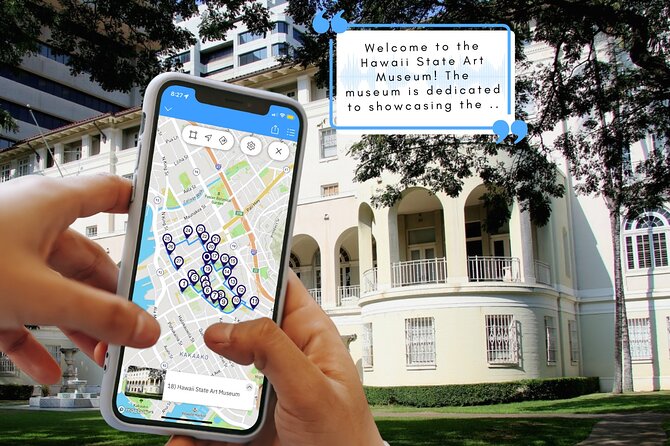
This is a smartphone audio walking tour of Honolulu’s Historic District, run by Tripvia Tours. After you book, you get a mobile ticket and a tour that you can keep and use anytime within the flexible dates window on Tripvia Tours. The practical win here is control: no set start time once you’re ready, and no strict clock pushing you forward.
Before you leave, the tour recommends downloading on Wi‑Fi so you can listen without signal needs. During the walk, you’ll use your phone or tablet (the tour requires one). There’s also a live GPS map that shows both the route and your location, which is a big help downtown where streets and blocks can look similar.
At each interest point, the commentary automatically plays. You can also listen from your device speaker if you forget earbuds, but the experience is much easier when you can hear clearly. One reviewer specifically advised earbuds because the audio was sometimes quiet.
Finally, this is a private activity: only your group participates. That matters if you’re traveling with family or friends and don’t want the awkward pause-and-wait rhythm of a group tour.
You can also read our reviews of more walking tours in Oahu



Price and Timing: $10.99 for 1–2 Hours of Landmark Storytelling
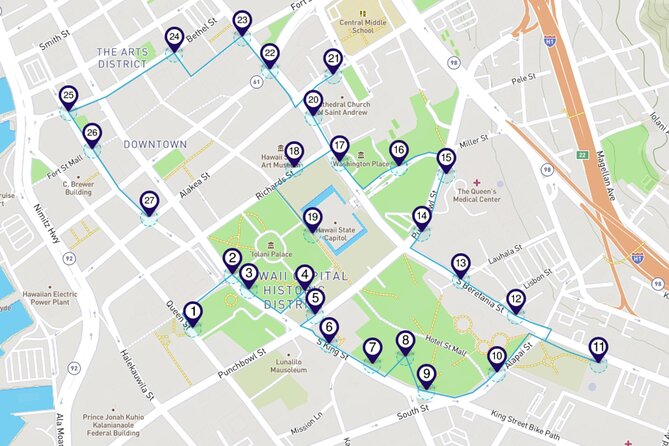
At $10.99 per person, this tour sits in the “small price, big payoff” category—especially if you like learning while you walk. You’re not paying extra for a bus, a driver, or a traditional guide with a set itinerary and set pacing. Instead, you’re paying for guided context at many points along a compact downtown loop.
Duration is listed as about 1–2 hours. In practice, that can mean anywhere from a quick listen with faster strolling to a slower pace with extra standing time. One review noted it lasted longer than expected, which makes sense because downtown landmarks tempt you to stop and look. The good news: the tour doesn’t lock you into a sprint.
Also keep in mind that many of these places are in full view outdoors, but the tour is not selling admission. Attraction tickets are not included, so you’ll want to budget separately if you decide to go inside anything.
Stop 1: Aliʻiolani Hale and the Start of the House of Heavenly Kings
You begin at Aliʻiolani Hale, located at 417 S King St. The audio opens with what the building is called: Aliʻiolani Hale, or the House of the Heavenly Kings. Even if you’ve never been to Honolulu’s historic core, this is a smart place to start because it’s instantly recognizable as a landmark.
From here, the audio approach helps you do more than just glance at architecture. You’re told what it represents in Hawaiian royal history and state-building—right at the threshold where the district’s story begins. This “start strong” factor is one of the best reasons the tour works. You get context early, so every later stop lands with more meaning.
Practical tip: since the tour has no time constraints, I’d take a minute at the start to orient yourself using the live GPS map before you move.
Stop 2: King Kalākaua’s 1879 Building Moment

Right after the initial landmark introduction, the audio explains that Aliʻiolani Hale was built in 1879 for King Kalākaua, who ruled the Hawaiian Kingdom. This is the kind of detail that transforms the view from “nice building” to “I understand what I’m looking at.”
What I like about the way the audio handles this stop is that it doesn’t treat architecture like trivia. It ties the building to who held power and when—so your brain builds a timeline as you walk.
If you prefer a museum-style approach, this tour won’t feel as structured, but that’s also why it’s easy to keep moving. You get the story without feeling trapped behind glass.
King Kamehameha I Statue: Folklore You Can Actually Picture
Next up is the audio stop tied to the statue of King Kamehameha I. The tour includes folklore about the celebrated monarch, and the statue becomes more than a photo-op.
This is one of the stops that works particularly well with an audio format. Standing still near a statue is exactly when a story belongs. The audio nudges you to connect names, reigns, and legend to a real place.
You can also read our reviews of more historical tours in Oahu




Kanaina Building and Victorian Architecture in Hawaii

The audio then points you toward the Kanaina Building, added to the National Register of Historic Places in 1978. It’s described as an important example of Victorian architecture in Hawaii.
This matters because it challenges the quick assumption that all historic architecture on Oʻahu looks the same. You get proof that downtown Honolulu includes imported styles adapted to local life. And even if Victorian details aren’t your obsession, the building is visually distinct enough that the context makes it easier to remember.
One caution: a few stops on this tour may feel more or less impressive depending on what you like to photograph and linger at. The good part is that the audio format lets you skip forward when you want.
Patsy’s Statue, 1879 Reading Rooms, and Keeping Sailors Out of Mischief

The next cluster of stops has a strong human angle.
First, you hear about Patsy’s accomplishments and why a statue exists for her. Even without deep prior knowledge, this kind of story usually clicks because it puts a person behind a monument.
Then the tour moves to a building described as a haven for book lovers. You’re told it started as a simple reading room in 1879, created to keep unruly sailors from getting into mischief. That’s a great example of the tour’s value: it gives the “why this existed” behind a feature you might otherwise pass by.
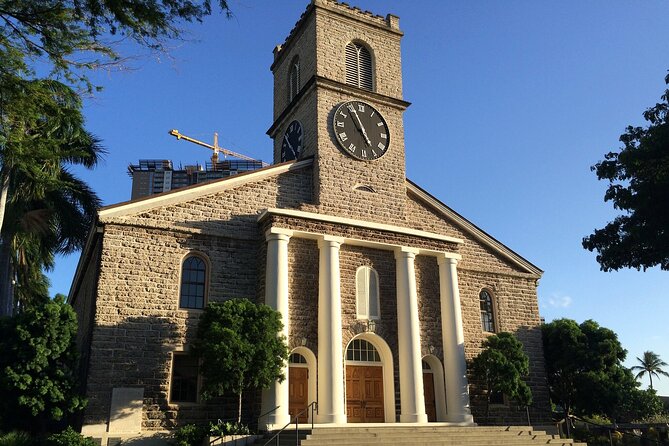
Then comes Hawaiʻi’s oldest church. The audio stop focuses on why it matters. This is another point where a story-driven audio guide helps. Churches are often seen as background scenery, but the audio nudges you to see them as historical markers of community life.
King Lunalilo’s Burial Choice and the City Hall Date Puzzle

At the next stop, the audio explains a royal burial decision: King Lunalilo refused to be interred in the Royal Mausoleum and instead is buried here. That kind of detail is memorable because it’s specific and a little stubborn—history with personality.
From there, you move to information about the city hall building construction, plus notable features the audio points out. Then comes a particularly interesting question: why are the years 1820 and 1915 engraved on the front if the building was built in 1921? The tour promises to explain the reason.
I like puzzles like this in walking tours. They push you to look longer and notice details—because once you’re aware something feels “off,” you can’t help but check the stone and read the years.
The Weird Sculpture, the Frank F. Fasi Building, and Police Department Notes
Next is a stop tied to an oddly shaped sculpture. The audio says there’s a story behind why it looks the way it does, and that it involves an interesting natural phenomenon.
After that, the tour moves to the Frank F. Fasi Building, described as Honolulu’s new municipal building as of 2006, with a unique design and a story explaining why. This is a helpful counterbalance in the route. You don’t spend the whole time only looking backward.
Then you’ll see relaxed-looking stone folks on the grounds for Seagull Schools, an early childhood education center. The audio also includes a note about something unique with the Honolulu Police Department. Since the tour description doesn’t spell out the specific detail here, you’ll hear it live through the audio at the relevant moment.
One extra reality check: if you’re expecting to enter palaces or ticketed sites, don’t. This is an outdoor walking tour, and attraction tickets aren’t included. There’s at least one lesson learned the hard way in the feedback: someone expected entry and felt disappointed. You can avoid that by treating this as a look-and-listen stroll, not a pass into indoor attractions.
Bell of Nagasaki to the Queen’s Conference Center and Hawaii State Capitol
The route then highlights the Bell of Nagasaki, described as a symbol of peace and friendship between the United States and Japan. That’s a powerful connection to have in a downtown walk. It makes a public landmark feel tied to current values, not just old dates.
Then you’ll reach the Queen’s Conference Center, a historic and cultural landmark of Honolulu. The audio explains that the complex was the brainchild of Queen Emma and King Kamehameha IV, and it gives you their vision.
In 1969, the audio says the building officially became Hawaiʻi State Capitol. That fact helps you understand why the area has civic gravity. It’s not just a pretty landmark zone—it’s where governance history and architecture overlap.
From a 1842 Clipper Captain Manor to a Hawaii Art Museum
The tour continues to a regal manor described as built in 1842 by a clipper ship captain for his wife and young son. That’s a fascinating bit of context because it places Honolulu’s historic downtown in the bigger web of travel and ocean trade.
After that, the audio points you to a museum dedicated to showcasing the art and culture of Hawaii. It’s labeled as a must-see destination for anyone interested in island traditions, and you’ll get the audio cue as you approach.
Then there’s a theatrical-feeling moment: you’ll hear what the Queen herself could have said, including the line that she was the last surviving member of the Kamehameha dynasty. Even if you’re not a “royal history” person, the audio style turns a distant story into something you can connect to stone and scenery.
Churches, Queen Emma Square, and Names That Shift Over Time
Next comes another important place of worship, described as another dream King Kamehameha and Queen Emma had for beloved Hawaiʻi. The audio frames the spiritual purpose behind the location.
Then you’ll hear about a small area originally named for Queen Emma and, as of 2016, shares that honor with James and Abigail Campbell. This is a helpful historical reminder: names change, and those changes often reflect community and legacy, not random rebranding.
If you like walking routes that include both major monuments and the quieter details, this part of the tour tends to land well.
Pedestrian Mall, Hawaii Theatre Center, and Kumu Kahua Theatre Stories
The tour moves into an area built for people on foot: a pedestrian-only street mall established in the 1960s to revitalize downtown Honolulu. The audio frames why it became a popular spot for shopping, dining, and entertainment.
Then comes the Hawaii Theatre Center, opened in 1922 to a world of vaudeville and silent film. That’s a neat time stamp because it connects Honolulu’s downtown entertainment history to broader American theatre trends.
Finally, the audio explains that the building was donated to the Kumu Kahua Theatre Company, formed with the goal of producing new works by Hawaii playwrights and works reflecting the diverse cultures and experiences of the people of Hawaiʻi.
This ending section is where the tour’s tone often shifts from “monument history” to “living culture.” You’re looking at a landmark that still matters, not just one frozen in time.
What You’ll Probably Love, Based on What Actually Gets Praised
Here’s what clearly works best with this kind of tour design.
1) The background info and voiced stories. The audio uses a narrative approach with voiced stories from historic people, which many people find more engaging than a plain script. That format makes pauses feel worthwhile.
2) You can set your own rhythm. One review specifically said it’s easy to skip and walk your own routes when you want. That’s the big strength of a self-guided setup: you’re not forced to care about every stop equally.
3) It’s good value for an afternoon. With a low price and a lot of named landmarks, it’s a strong option when you want something structured but not expensive. The price works best if you actually listen to the audio rather than treat it as background.
4) Earbuds can fix the main comfort issue. At least one review flagged quiet audio. If you bring earbuds, you’ll likely enjoy it more, especially in street noise.
A small balance note: not every stop will feel equally impressive. The tour covers many points, so your attention will naturally pick favorites.
Should You Book This Honolulu Historic District Audio Tour?
Book it if you want a low-cost, flexible way to learn about downtown Honolulu while you walk. It’s especially suitable if you like history that’s told in human-sized stories—kings and queens, civic decisions, and public landmarks—without paying for a full guided group.
Skip or adjust your expectations if you’re hoping for site entry beyond what you can do outdoors. Attraction tickets aren’t included, and at least one person found this frustrating when they expected palace access.
My rule of thumb: if you’re planning to spend at least an afternoon in the area anyway, this tour is a smart way to turn that time into something more meaningful. You’ll get a guided route, automatic narration at points of interest, and plenty of moments where the details start connecting.
If you do one upgrade, make it simple: bring earbuds and plan to start earlier if it’s hot.
FAQ
How long is the Honolulu Historic District smartphone audio walking tour?
It’s listed as about 1 to 2 hours, depending on your pace.
What language is the tour offered in?
The audio is offered in English.
Do I need an internet connection during the tour?
You can download the tour on Wi‑Fi before you start. The information provided says no signal is required or data used during the tour.
Does the tour include headphones?
Headphones are not included. Audio can play from your device speaker, and earbuds/headphones are optional.
Are attraction tickets included?
No. Attraction tickets are not included.
Do I need a smartphone or tablet?
Yes. A smartphone or tablet is required for the audio and the GPS map.
Where do I start the tour?
The meeting point is Aliʻiolani Hale, 417 S King St, Honolulu, HI 96813.
Is the tour guided by a person?
It’s an audio tour. Commentary automatically plays at each point of interest, with a live GPS map showing your route.
Is this tour private?
Yes. Only your group will participate.
What’s the cancellation window?
Free cancellation is available up to 24 hours in advance for a full refund. Within 24 hours, it’s not refundable.